

Video at the bottom of the article!
Every so often, I find myself involved in something that could only really be described as bonkers. A couple of months ago, a very good friend of mine texted me to ask if, as a Mountain Leader, I thought that ‘juggling the three peaks was possible or not?’ I’ll admit that I laughed – my reply was basically that yes it was theoretically possible. I didn’t add that I thought the idea was borderline crazy. Nothing more was said.
Then, a month ago, we agreed to ‘recce’ the route. It had been twelve years since Chris had walked the three peaks route in Yorkshire, and that was again with me. I pencilled the 20th May into the diary. I had a few route ideas, but nothing concrete. Time passed.
A couple of days before Saturday, I realised we actually were going to head up there and check things out. It was actually going to happen. I began to think, just a bit, that he might decide to try it properly at a later date, and this made me think seriously about route options. I wanted to pass him the best advice possible. I’ve led many groups and people across the 3 Peaks, and for the vast majority the reason if they fail is due to personal fitness – mental and physical. It helps if you have done many sections as part of short walks first. It also massively helps if you’ve been doing lots of marathon training, like Chris!
Now, for those reading who have completed the ‘official’ Y3P route, you will probably remember two tough sections of hands-on scrambling. One of these is a Grade 1 section on Pen y Ghent, the other a softer Grade 1 section on Ingleborough. Both require the use of hands. In other words, you can’t juggle your way up them. So how to avoid them both and still complete the circuit?
You’re left with two options. The first is to start somewhere like Ingleton (miles off the official route) and head up Ingleborough, over to Pen y Ghent from the north west (not south east), then retrace your steps and bear off north towards Whernside, descend this and take the road back to Ingleton. The other option, which I realised only the night before we set off, is to park in a central location near Ribblehead, and do three ‘there and back again’ routes. You’re still summiting all three peaks, but there’s no tough scrambling section. See map and stats near the video at the bottom of the page. Plus, an eastern ascent of Ingleborough is much less crowded making it easier to concentrate on something like juggling. But it is bloody steep, which is a challenge. Chris made it look easy though to be honest (watch the video!)
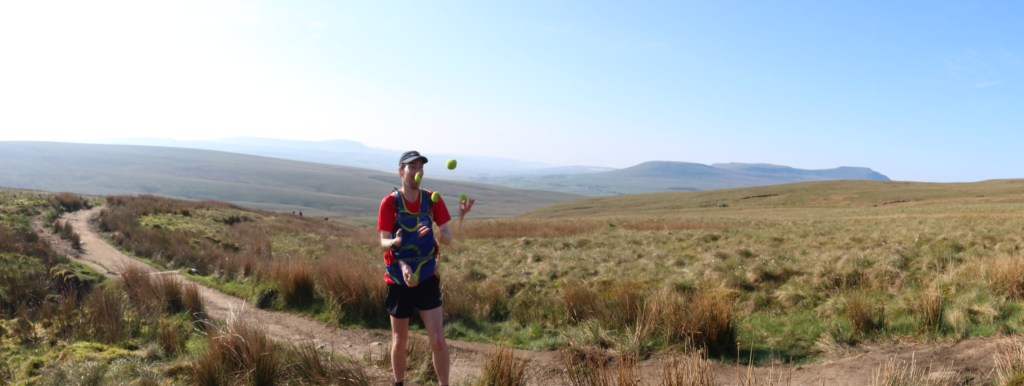
The only problem is that whichever alternative route choice you make, you add mileage. Ours clocked in at 33 miles. That is a long day out for walking, never mind adding juggling into the mix.

We set off at 6am from Saltaire train station, with the new Metallica album ’72 Seasons’ playing in the CD drive. As I drove up through the Dales towards Settle, both of us got psyched up to the sound of Lux Aeterna and discussed route options. I gave Chris a choice – regular route with scrambles, Ingleton route, or central route. He immediately chose the central route so we could travel lighter and refuel easier. I was very pleased he chose that. The others would have been a huge commitment.
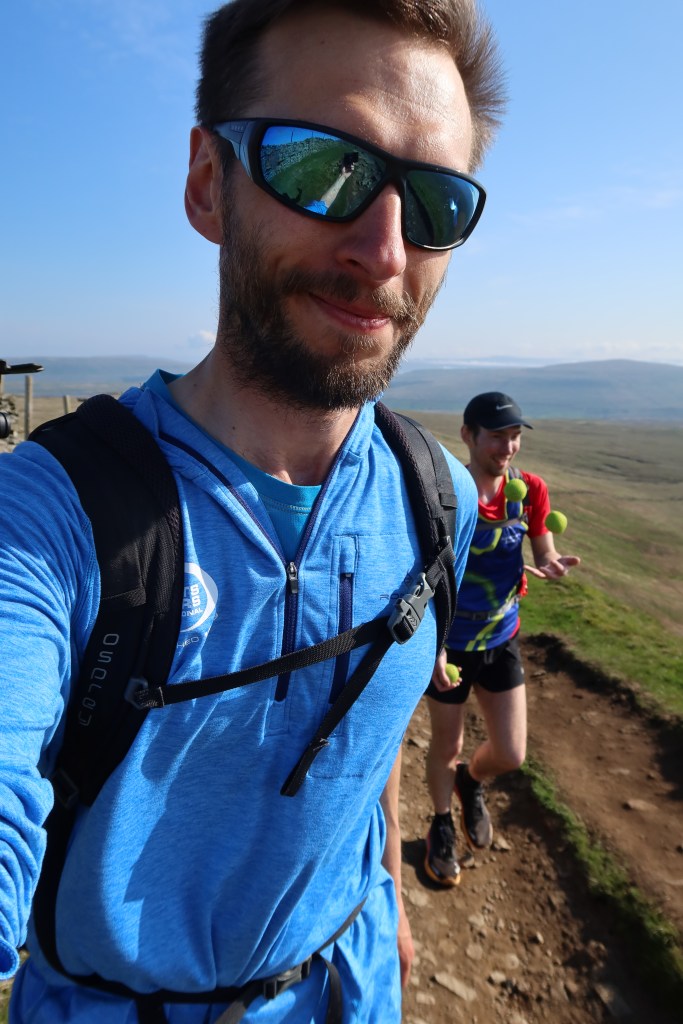
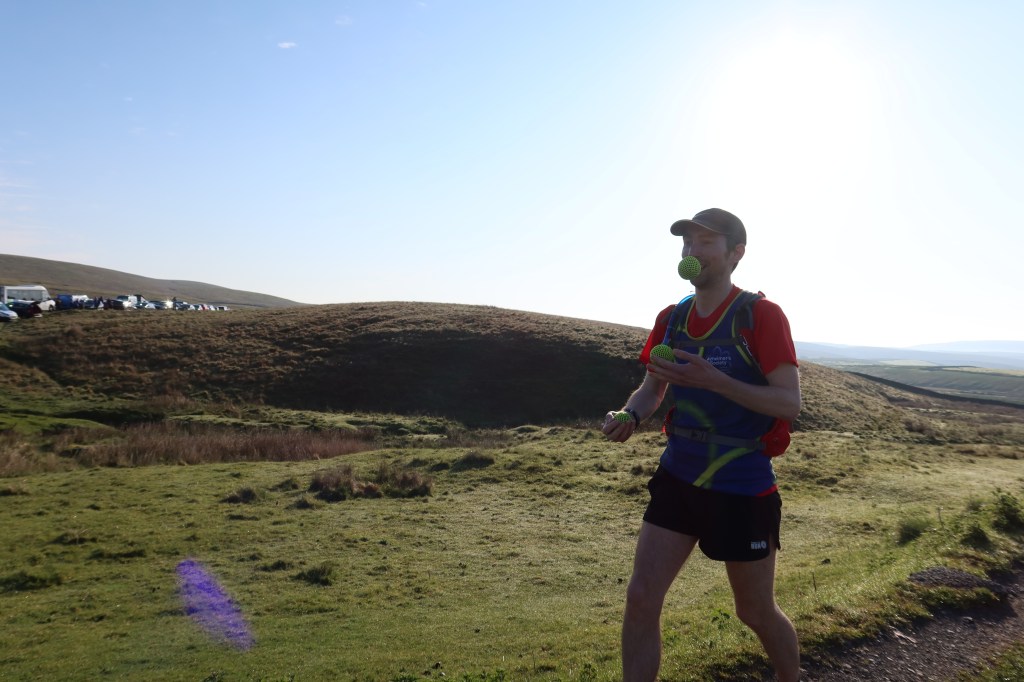
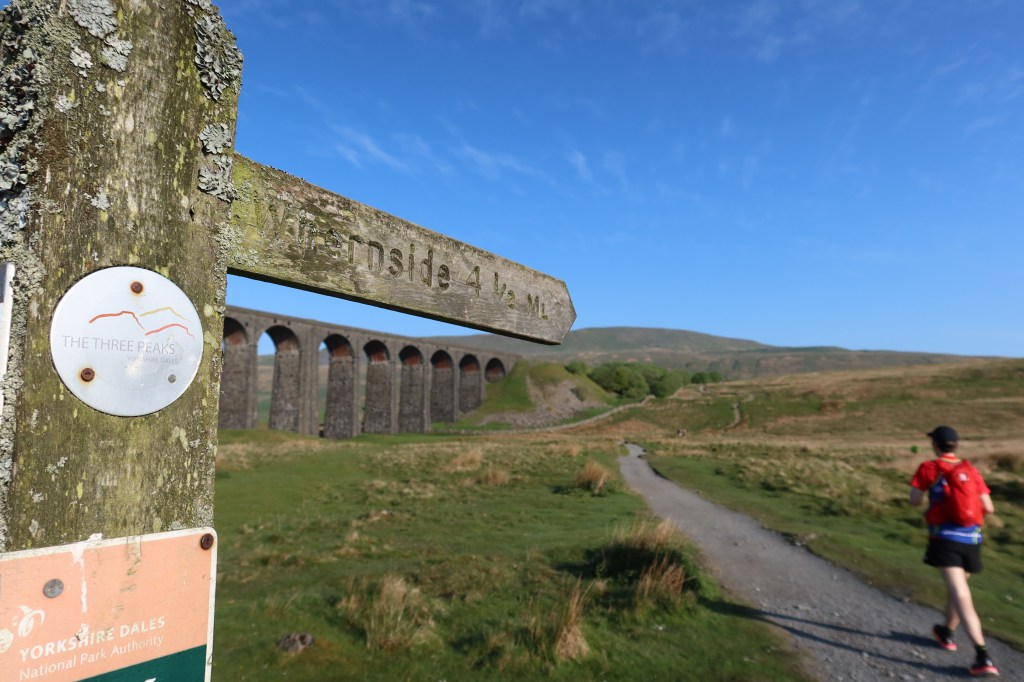
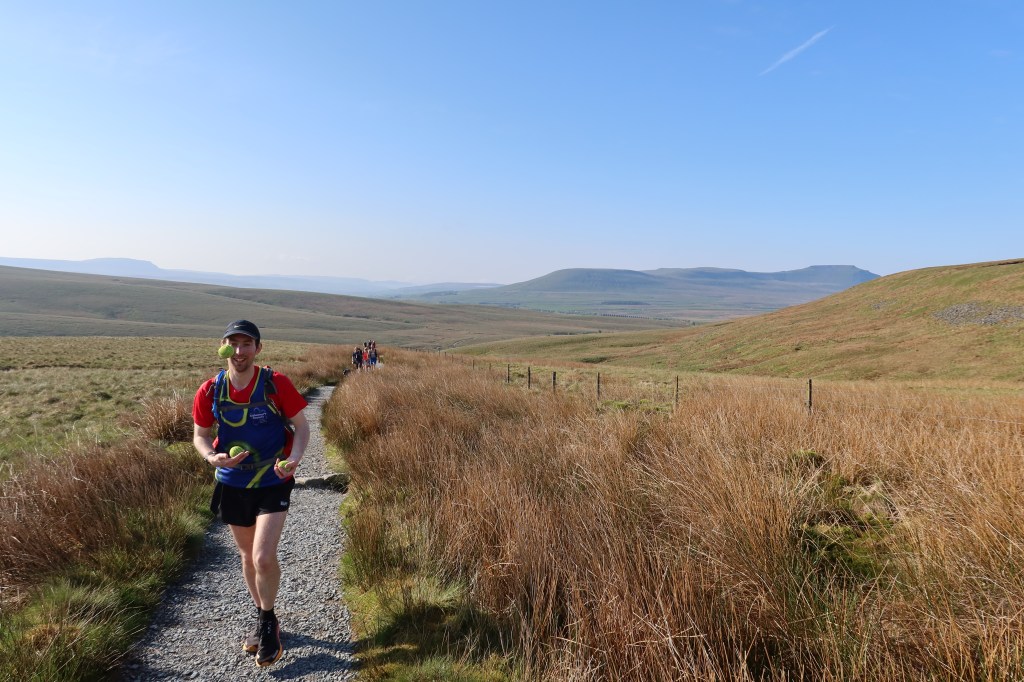
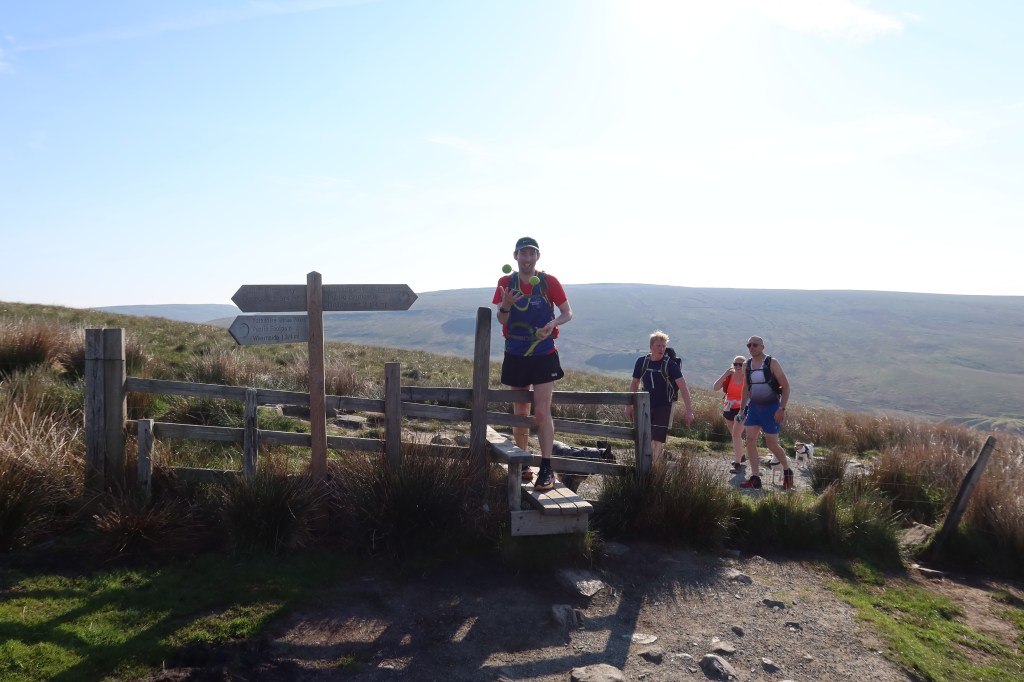
And then he dropped the bombshell. He was going to juggle it today. I had assumed we were doing a bit of a recce – nope, today was ‘record breaking’ day. He had a point – the weather was unbeatably good. Low wind speeds, cloudless sky, bone dry. Perfect. See pictures, taken during the actual event. Right, game on then! If I could navigate him flawlessly through the alternative route then we might have a chance.
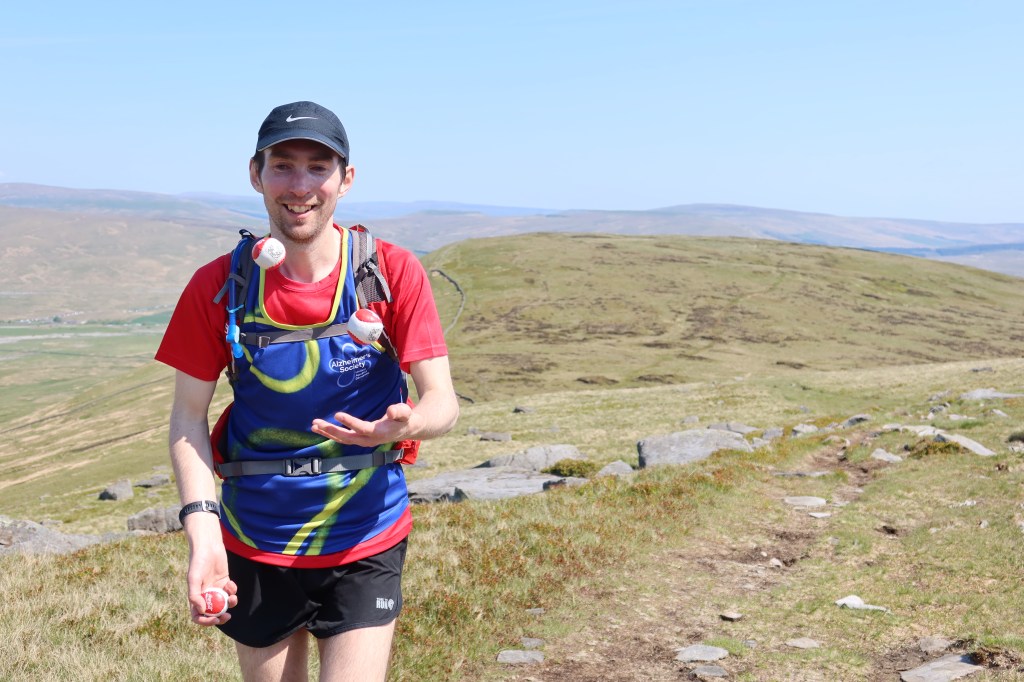
After ditching most of our kit into the boot of my car, not only were we much lighter but also much more mentally ‘psyched’ that the going would be a bit easier than expected. We’d need every ounce of energy for this. I started out guiding Chris nearly every step, describing lots of rocks, telling him ‘left’ or ‘right’ or simply ‘follow me directly’. We had an understanding that if he was finding the terrain tricky, I would be finding the easiest route possible, so he could simply follow. Many times he chose a trickier route which was really impressive. He also adjusted to the new environment for juggling really quickly – he’s used to roads and special tracks. A mountain path is very different, with lots of irregularities that caused him to struggle with the rhythm of juggling. Having said all of that, Whernside was thoroughly obliterated, dispatched and descended. We were back at the car nearly before I could blink, including a rapid descent to test out my own newly recovered lower back injury. Chris was also recovering from a leg injury, so we were barely back up to fitness.

Lots of people cheered for Chris en-route. This gave him a visible boost to performance and the worst section of his juggling by a long way was the quiet section ascending Ingleborough. After Whernside, we had two ‘there and back again’ routes to do for the remaining two peaks. There was no need for a circular route as our plan would still include all three peaks with opportunity for refuelling. We hiked the ‘regular’ route towards the turn off for Pen y Ghent but before the infamous cattle grid and disused farm buildings, headed right, up a public footpath, past a small nature reserve, and straight up the lower slopes of Ingleborough towards a summit called Park Fell (563 meters). Keeping the dry stone wall on our left, we handrailed this along the ridge line, with the plateaued summit of Ingleborough looming ‘like a monolith’ ahead, according to Chris. Soon enough, we had rejoined the regular path, above the zig-zag scramble, and it was incredibly busy. Chris somehow managed to juggle through everybody, even managing an extraordinary high step without any drops. There was one drop right at the end on reaching the rocky summit. There were people there who had seen Chris on Whernside and were simply in disbelief that he was still going. We met some of them later on Pen Y Ghent as well who actually paused to cheer him on and even opened gates for both of us. This was an amazing experience!
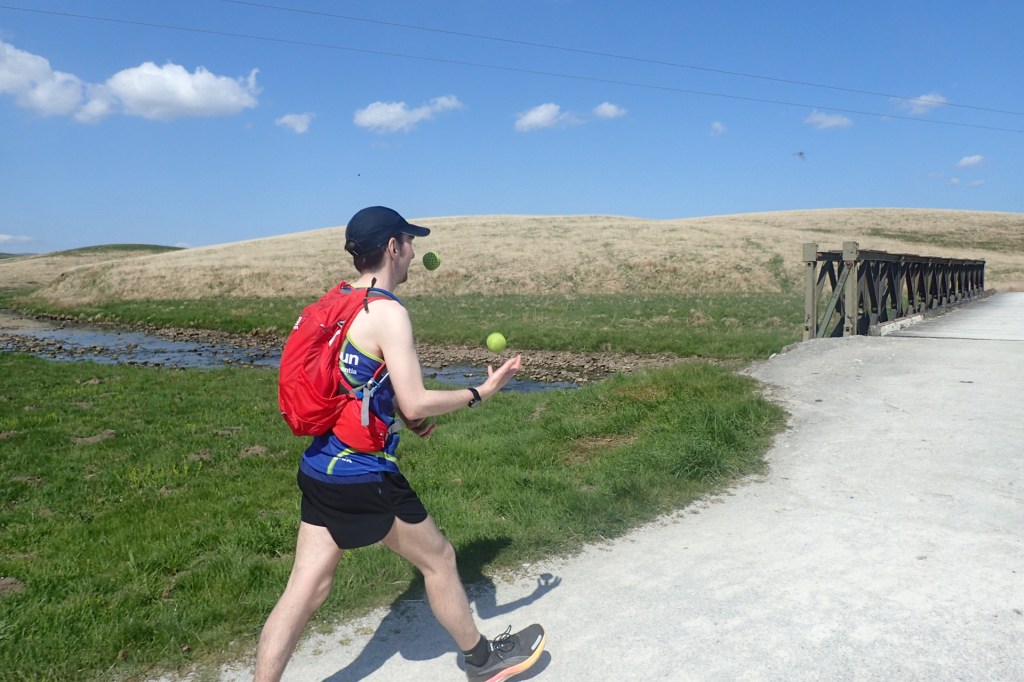
Chris had switched to lighter juggling balls on the ascent of Ingleborough. 90g each, apparently, instead of his regular 120g balls. His performance using lighter balls was comparatively drastically worse, and began impacting his morale. I suggested a switch back to heavier ones for a while and this worked. I know him well enough to make comments like this but it’s not something I would have said to any other athlete which is quite interesting. The heavier ones were made differently, and bounced off each other much less if they collided in mid air.
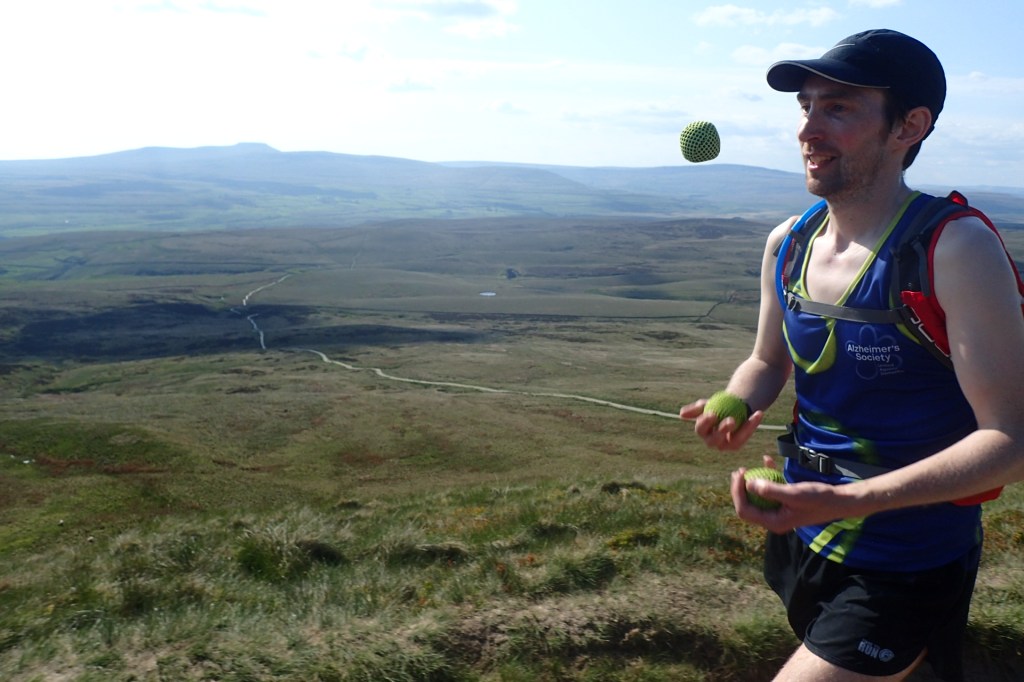
On the descent of Ingleborough, I dropped behind Chris to watch how he was moving. I wanted to make a leadership decision based on how he was doing. I could tell from some of his comments he was in two minds whether to continue and I knew that if I were to help him as much as possible I needed to arrive at an absolute decision fairly quickly. He was moving well enough, no stumbles, no sloppiness, but his communication had changed a bit. He was definitely tiring out, and the sun was beating down mercilessly by now. After observing him make it down without any support or guidance, I knew he could handle the terrain and the endurance mentally. But I knew that hydration was the key. Did we have enough for both of us? I also know that both Chris and I tend to play down problems. Hydration was not one that I wanted to mess about with – we either had enough and game on, or not and we stopped, with a lesson learned.

I then had a brainwave. There was a pub at Ribblehead, surely open by now, where we could grab a quick glass of water and maybe some coke. Not ideal but better than dry mouths for ten miles. Back at the car, I asked Chris how he was doing and he answered as I figured he might. He was also concerned about fluids. We both had just one bottle of drink left for the last peak. I suggested Ribblehead pub, ten mins down the road. We could stop the clock, have a break, he could rest his arms, and then we could press on in safety. We actually chose to keep the clock going. Two glasses of water and a coke for myself later, we were feeling a million times better. The initial stages of Pen y Ghent were completed really quickly, and then we both began to slow. I started making checkpoints for us, and voiced another leadership decision on my part – we would decide whether to push on to the summit of Pen y Ghent at a place I called ‘the crossroads’ – the spot where the pathway of ‘A Pennine Journey’ meets ‘The Pennine Way’ at the base of Pen y Ghent. A charity group had already gathered there when we arrived. Both of us were by now pretty tired, and being tactical with the dwindling supplies of our rations. I was actually a bit concerned about how lightweight we were – air gets a lot colder as you get higher, and the wind usually picks up. Neither of us had a second layer to put on, and were wearing short sleeved technical wicking tops. Another pre-agreed decision – we would spend minimal time on the summit, pausing long enough to take audio visual evidence and then heading down. Chris immediately agreed, and I could see he was looking strained and tired. Both of us were reaching our limits mentally and physically. Be under no illusion – I wasn’t in charge of Chris and he could decide whatever he liked, including quitting. I wouldn’t stop him doing that, but I would absolutely do everything I could to support him and make sure both of us crossed the finishing line still on our feet.
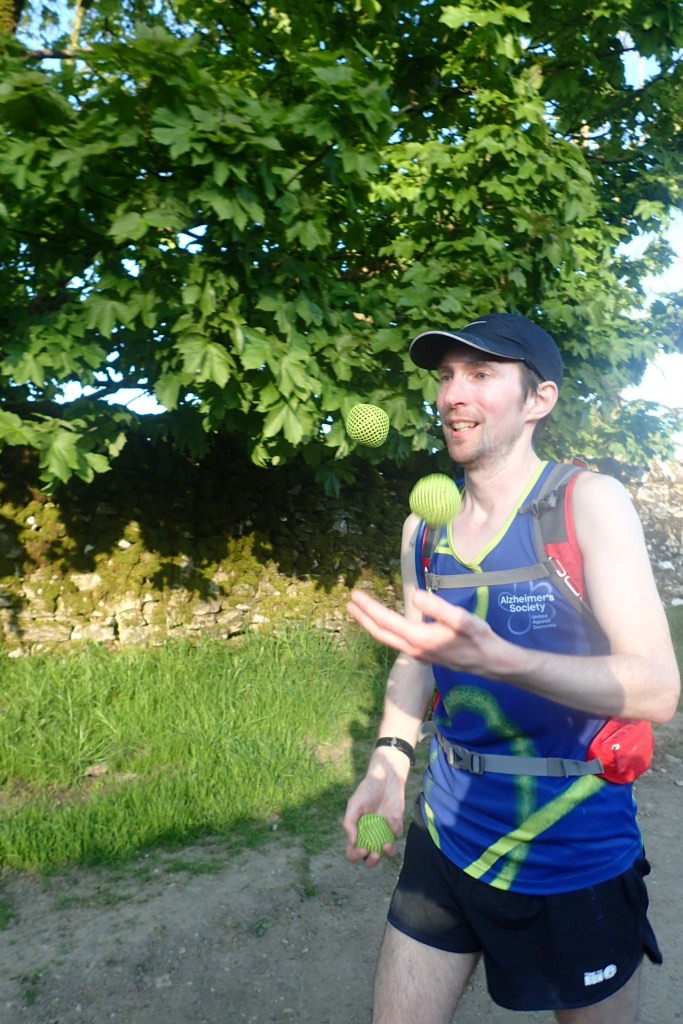
We set off, much slower than our usual pace. The ascent of Pen y Ghent is harder than it looks, and much steeper. There was a moment just before the big swing to the right on the path toward the top when both of us had a wall to push through in terms of fatigue. By slowing right down, we made it. The steps at the top nearly killed our legs, and I heard Chris describing them as a ‘Stairway to Heaven’ – they just kept on going. We really did not want them to keep going. Finally, the summit, a final stile, the trig point, a quick photo, some footage.

Then off. A fan paused for a selfie with Chris on the descent of the steps while I quickly got down them. Steps like that on a descent have done immense damage to my lower back in the past and now I use two poles bearing most of my weight to make progress. Part way down Pen y Ghent I went blind in my left eye – some sweat had mixed with the suncream I was applying and had trickled through my eyebrows and into my eye. It stung horribly, just at a moment when the path steepened with loose gravel sections. An ideal place for an accident. Luckily we made it through.
Back at the crossroads, Chris wanted to push on before we have one final rest, one final bite to eat. Both of us drain our bottles totally dry, and finish the very little remaining food. This is the riskiest part of the day in my opinion, when totally tired and out of supplies. All it takes is a lapse in concentration, a minor accident, and suddenly the day takes a turn for the worst. I forced myself to pay attention. One wrong turn, one misjudgement, could ruin an otherwise excellent day.
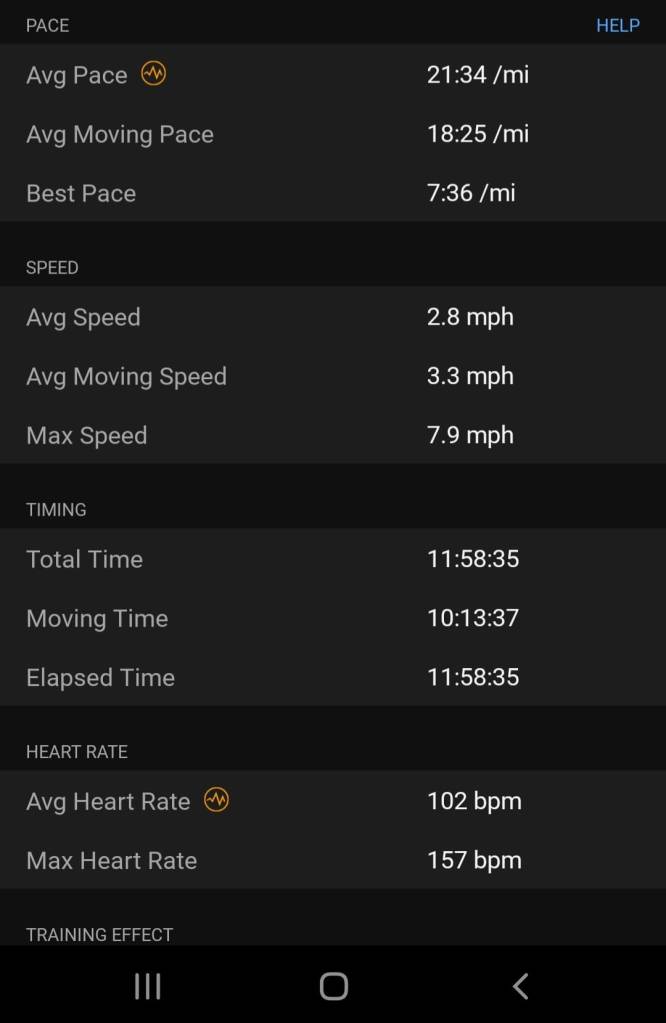
According to the stats on Chris’ watch, our final couple of miles were the fastest of the day, clocking in at 15 mins each. That’s a super quick pace at the best of times, but after a 30 mile day, with Chris constantly juggling, it’s amazing really. In the video you can hear me nearly slurring through tiredness, and Chris is less than his usual chirpy self. We were both utterly spent. On the drive back, I rubbed my eyes while turning a corner at nearly 40 mph and went blind again with the familiar sting of suncream. Not ideal. An emergency pull over and lots of blinking (we were out of water) did the trick.

On Saturday 20th May, Chris Edwin became the first recorded person to juggle every step of the Yorkshire Three Peaks. I am fortunate that he is a very good friend of mine and asked me to lead him on this tough mountain journey.
Interview, map and stats:
A few questions I asked Chris, and his replies, as follows:
- How long have you been juggling/joggling? (joggling is the sport of jogging and juggling at the same time)
”I learnt to juggle when I was about 17 but then didn’t really do it much for years. Then in 2021, after the pandemic, I was due to take part in the re-arranged Manchester Marathon. I couldn’t get the motivation to train for it and my cousin came up with the idea of juggling it for a charity instead. We had no idea that this was already a sport that exists called joggling! It quickly became my passion and I’ve been doing it for two years now.”
2. What inspired you to attempt the Yorkshire 3 Peaks challenge and what did you do differently to train for it?
”I have joggled several marathons and was interested in how long I could physically juggle for and the endurance implications on the body and mind. I hadn’t done the three peaks for many years and came up with the idea to juggle it whilst walking. I thought something like this had never been done before but also guessed it may be too hazardous or even impossible! I practiced juggling up and down steep steps to replicate what it might be like and juggled over some small rocks in my local countryside. I didn’t have long to prepare after my latest joggling marathon so was relying on muscle memory and having an experienced guide to get me through!”
3. What was your lowest moment on the route and how did you mentally overcome it?
”It was probably after about four hours when ascending the second peak, Ingleborough. At this point my forearms were getting surprisingly tired and fatigued. I wasn’t used to this and switched to lighter juggling balls for a bit but this resulted in more drops than expected. This negativity got into my head a bit and for a short while I had doubts I could last the many more hours required, thinking I would be dropping way too much. Luckily this soon went away after a short break and when the adrenaline of doing the tricky , final Ingleborough ascent set in. It helped having more walkers around again as their presence seemed to sharpen up my mind and I got more energy from their comments. The drops mostly stopped and I didn’t even notice my tired arms for long periods after.”
4. If you could do it again what would you do differently?
”I would probably do a bit more walking whilst juggling training in general. Nearly all my extensive training was running-based (joggling) and I learnt this is very different from the mechanics of juggling whilst hiking over uneven terrain. Practice makes perfect of course. I learnt that going down is harder than going up so would practice this more. Overall though, I was very pleased with how it went, having a great guide to follow the whole way and alert me to hazards was key!”
5. Any advice for aspiring athletes?
” I would say just follow your dream and don’t worry about failing first as this is how you get better. Consistency, day in day out, is the most important thing and that’s the only way to perfect your art. Just keep showing up. People probably thought I was crazy when I started and may still do so, but ultimately I set out to do something that seemed impossible at first and won’t stop until I get a world record – that’s the beauty of sport in general, never give up!”



 leadforaliving.co.uk
Leave a reply to leadforaliving1409 Cancel reply