
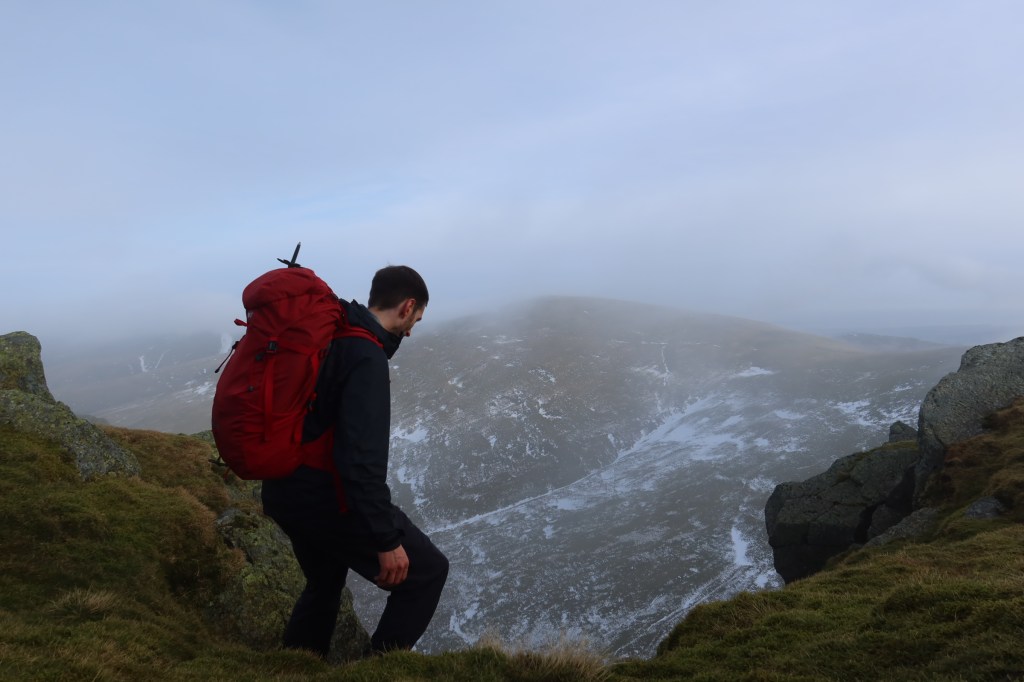
If you’ve been hiking in the British mountains for some time, you might be considering taking the next step – off-path navigation. You might have lots of different reasons for wanting to do this, and the benefits are huge when you gain confidence with a map and compass. But where to start trying this out? This blog (and video below) offers some theory with practical application to enjoy a remote approach to one of the busiest summits in the Lake District.
- 1. Plan, Plan, Plan…
You know the old saying: Prior Preparation Prevents Pretty Poor Performance. Learning to navigate is no different. The more you study guidebooks and maps before you head out (or my YouTube videos, plus all the other great videos out there), the clearer the impression you will have of the landscape and what to expect. Knowing in advance where cliffs, water hazards and bogs are, can be really helpful.
- 2. Wait for a good weather day
Although it’s fun to navigate through the mist, when you start out it’s wise to wait for good weather. This is because if you make mistakes you’re far less likely to end up wandering blindly over a cliff edge or straight into a bog. Plus, on a calm sunny day you can plan a viewpoint into your walk and enjoy a peaceful picnic with awesome scenery – what’s not to like?
- 3. Start off small – marginal gains add up over time
In the video, I joined two indistinct tracks by taking, and following, two bearings. One was from Brund Gill, and the next was on the approach to the summit of Whiteside when the path just runs out. I didn’t put bearing information in the video as they depend exactly on where you are standing. You’re never really that far from a track of some kind in the Lakes, especially the eastern fells, so joining tracks up in this way can be a fun method of gaining confidence. Also, revisit areas you have navigated in good weather during times of less pleasant weather. You will know the area fairly well and see how trustworthy your new skills are becoming. The more you do it, the more mistakes you will inevitably make, and I speak from personal experience that out of all the thousands of times I’ve used a compass, on only two occasions have I nearly come to a sorry end. Both were in full winter whiteouts. You should avoid winter conditions until you have had plenty of bad weather experience first.
- 4. Take a ‘proper’ map and a ‘proper’ compass with you
No, that’s not a way of saying your brand new phone and smartwatch! I mean a paper copy of a map, and a physical compass. By following these carefully in places you know really well, you can begin to decipher what the symbols mean and what the scale feels like. These are the two key aspect of off path navigation. If you can’t understand the symbols, and you don’t know anything about scale, then it gets really tricky to navigate. Basically, you’ll be lucky if you end up where you are aiming for. Paper maps have the advantage that they never run out of battery, you can use a compass with them (don’t put a compass near your mobile phone as it will rapidly demagnetise!) and they are perfect for scribbling on bearings in advance. I put pen and pencil marks all over my maps before heading out.
- 5. If you get into difficulty, stop immediately!
It’s really tempting, when you have no idea where you are, to ‘keep going until I see something I recognise’. This is probably the single biggest cause of mountain accidents (I’m assuming?!) It’s actually far safer, though less exciting, to turn back and go to where you were last super confident of your location. Maybe it means using the path after all and hiring a mountain leader to teach you the skills needed.
Ultimately, good navigation stems from having a solid method to use in any circumstances, and years of experience making good judgements in the mountains. Naturally, you don’t get either of these unless you make mistakes and also reflect on them. If your route doesn’t go to plan, no worries – analyse it with mates over a cuppa when you get back. The important thing is you get back safely, even if your ego does take a bruising. What went wrong? What do you need to do next time? Is there a key skill you need to practice? I’ve had everything go wrong from jammed compasses (frozen solid) through to navigating 180 degrees in the wrong direction.
Fun tip: Head somewhere with a bunch of mates and volunteer to be their leader for the route. Or take it in turns to lead. Have a laugh, don’t take yourself too seriously, and consider taking a GPS device on your phone to use if you’re not too sure. But once you get the hang of it, off-path navigation transforms you from a keen hiker, to a pro explorer, with leadership potential.
And maybe, with enough practice, you’ll decide to do your Mountain Leader training…

 leadforaliving.co.uk
Leave a comment